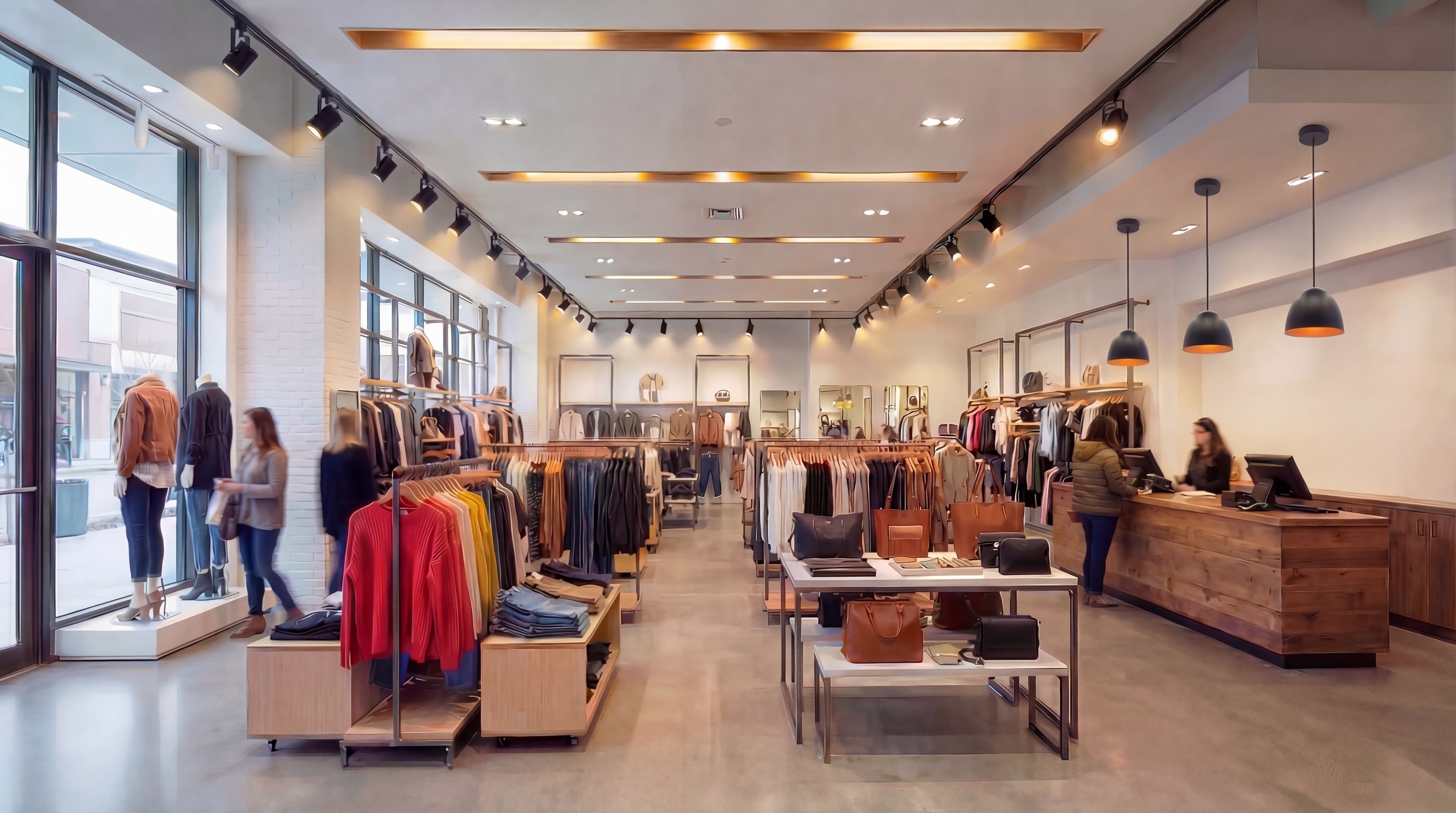

Lighting can make or break a retail environment. The right LED fixtures do more than illuminate products; they shape how customers perceive your brand, influence how long shoppers stay in your store, and directly affect purchasing decisions. According to the U.S. Department of Energy, LED lighting uses at least 75% less energy than incandescent options and lasts up to 25 times longer, making it the most practical and cost-effective choice for modern retail spaces.
This guide covers everything you need to know about choosing, installing, and optimizing LED lighting for retail stores. Whether you are a store owner, interior designer, architect, or contractor, you will find actionable recommendations backed by industry standards and expert resources.
Table of Contents
- What Lighting Works Best for Retail Stores?
- Best Color Temperature for Retail Lighting
- Recommended Retail Lighting Fixtures
- Accent Lighting for Merchandise
- Glare Control in Retail Lighting
- Lighting Controls and Smart Dimming
- How Many Lumens Does Retail Lighting Need?
- Retail Lighting Layout Example
- Frequently Asked Questions
- Retail Lighting Checklist (Summary)
What Lighting Works Best for Retail Stores?
Retail stores perform best under 4000K LED lighting with a high Color Rendering Index (CRI) of 90 or above. This combination delivers neutral white illumination that renders merchandise colors accurately without skewing warm or cool. According to the Illuminating Engineering Society (IES), accurate color rendering and appropriate illuminance levels are among the most critical design factors in retail lighting, directly affecting how customers perceive product quality.
The IES Lighting Handbook identifies several key performance criteria for retail environments, including CRI, correlated color temperature (CCT), glare control, and luminance ratios between display areas and circulation zones. A well-designed retail lighting plan balances all of these factors to guide customer attention and create a comfortable shopping atmosphere.
Why CRI 90+ Matters in Retail
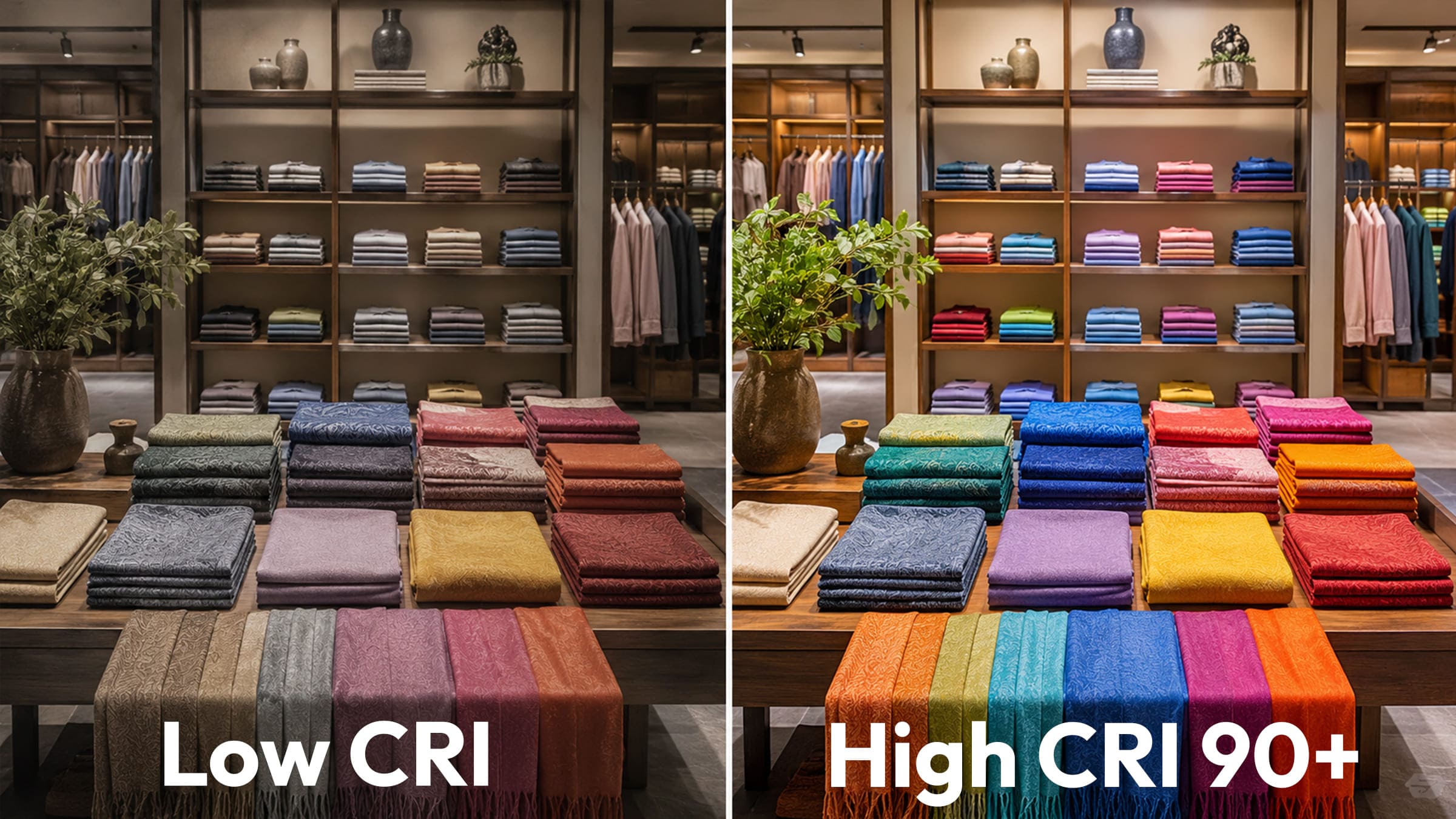
CRI measures how faithfully a light source reproduces the true colors of objects compared to natural daylight. On a scale of 0 to 100, sources rated 90 and above are considered excellent for color-critical applications. In retail, high CRI lighting means fabrics look rich and true-to-life, cosmetics display their actual pigments, and food products appear fresh and appetizing.
Research and expert guidance consistently point to CRI 90+ as the standard for retail merchandise displays. Lower-CRI lighting can make products appear dull or washed out, potentially leading to reduced customer confidence and increased product returns. This is especially important for fashion, cosmetics, jewelry, grocery, and home decor retailers where color fidelity directly influences the buying decision.
For a deeper understanding of CRI and how it affects lighting quality, the U.S. Department of Energy's LED Color Characteristics provides an authoritative technical overview, noting that a CRI of 90 or higher indicates excellent color fidelity and recommending the supplemental R9 value for evaluating saturated reds.
Lighting by Retail Store Type
Retail stores come in many shapes and sizes, from a 1,200 sq ft boutique to a 180,000 sq ft home improvement warehouse. The right LED lighting solution for each environment varies significantly depending on ceiling height, product type, customer dwell time, and the visual experience you want to create. What works beautifully in a jewelry store would fall completely flat in a grocery aisle, and the bright 5000K daylight used in a hardware warehouse would feel harsh and unwelcoming in a fashion boutique.
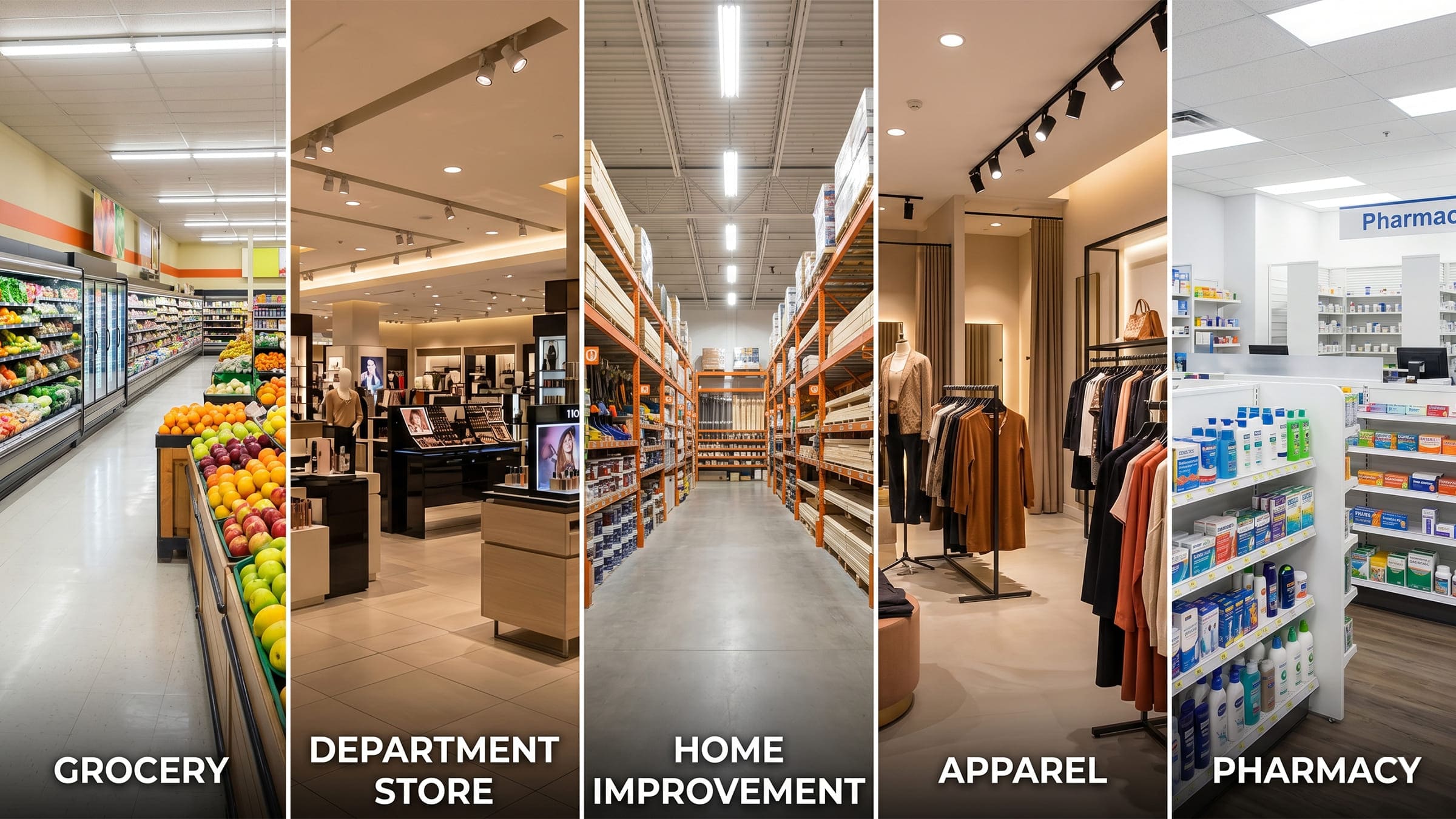
The five largest U.S. retail categories by total occupied square footage are grocery and supermarkets, mass merchandise and department stores, home improvement, apparel and clothing, and pharmacy and drug stores. This ranking is consistent with retail industry data from sources like the NRF Top 100 Retailers list, which tracks the largest U.S. retailers by sales and store footprint. Square footage matters because lighting requirements scale directly with floor area: the larger the space, the more fixtures, lumens, and footcandle targets you need to plan around. Each of these five categories has distinct lighting requirements driven by its product mix, ceiling height, and customer experience goals:
| Retail Store Type | Examples | CCT | Min. CRI | Primary Fixtures | Key Priority |
|---|---|---|---|---|---|
| 1. Grocery / Supermarket | Kroger, Publix, Whole Foods, Albertsons, H-E-B | 3500K-4000K | 90+ (R9 critical for meat and produce) | Linear high bays, flat panels, recessed downlights | Food freshness rendering, energy efficiency at scale |
| 2. Mass Merchandise / Department | Walmart, Target, Costco, Sam's Club, Macy's, Kohl's | 4000K | 85-90+ | Recessed downlights, flat panels, track lighting | Consistent coverage across mixed product categories |
| 3. Home Improvement | Home Depot, Lowe's, Menards, Ace Hardware | 5000K | 80+ (90+ in paint/color matching areas) | UFO and linear high bays, vapor-tight strip lights, task lighting | Maximum visibility, ceiling heights 20-40 ft |
| 4. Apparel / Clothing | Gap, H&M, Zara, Nike, TJ Maxx, Old Navy, Lululemon, boutiques | 3000K-3500K | 95+ (R9 critical for fabrics and skin tones) | Track heads, adjustable spotlights, pendants | Color fidelity, skin tone flattery, brand atmosphere |
| 5. Pharmacy / Drug Store | CVS, Walgreens, Rite Aid | 4000K | 90+ | Flat panels, recessed downlights, accent track for beauty aisles | Label readability, clinical cleanliness, cosmetics rendering |
Recommended Westgate Fixtures by Retail Type
1. Grocery / Supermarket — UHX Series UFO High Bays for open-floor formats with high ceilings; LPNP Series DLC Premium Back-Lit Flat Panels for lower-ceiling grocery sections and produce aisles.
2. Mass Merchandise / Department — LRD-WTM1 Series High CRI Recessed Downlights for general floor ambient coverage; TRD-MCTB Series Track Heads CRI 90+ for zone accenting across mixed merchandise.
3. Home Improvement — UHXMAX UFO High Bay Beam Adjustable Sensor Ready for warehouse-height ceilings of 20 to 40 ft; LED Linear High Bay for aisle-by-aisle linear coverage.
4. Apparel / Clothing — TRD-MCTB Series Zoomable Track Heads CRI 93-95 for precision accent lighting on fashion displays; LCFD Series Dome Pendants for boutique atmosphere and checkout focal points.
5. Pharmacy / Drug Store — LPNP Series LED Backlit Flat Panels for clean, even illumination in general aisles and grid-ceiling formats; LED Pendants for checkout counter focal points.
Recommended Fixture Types for Retail
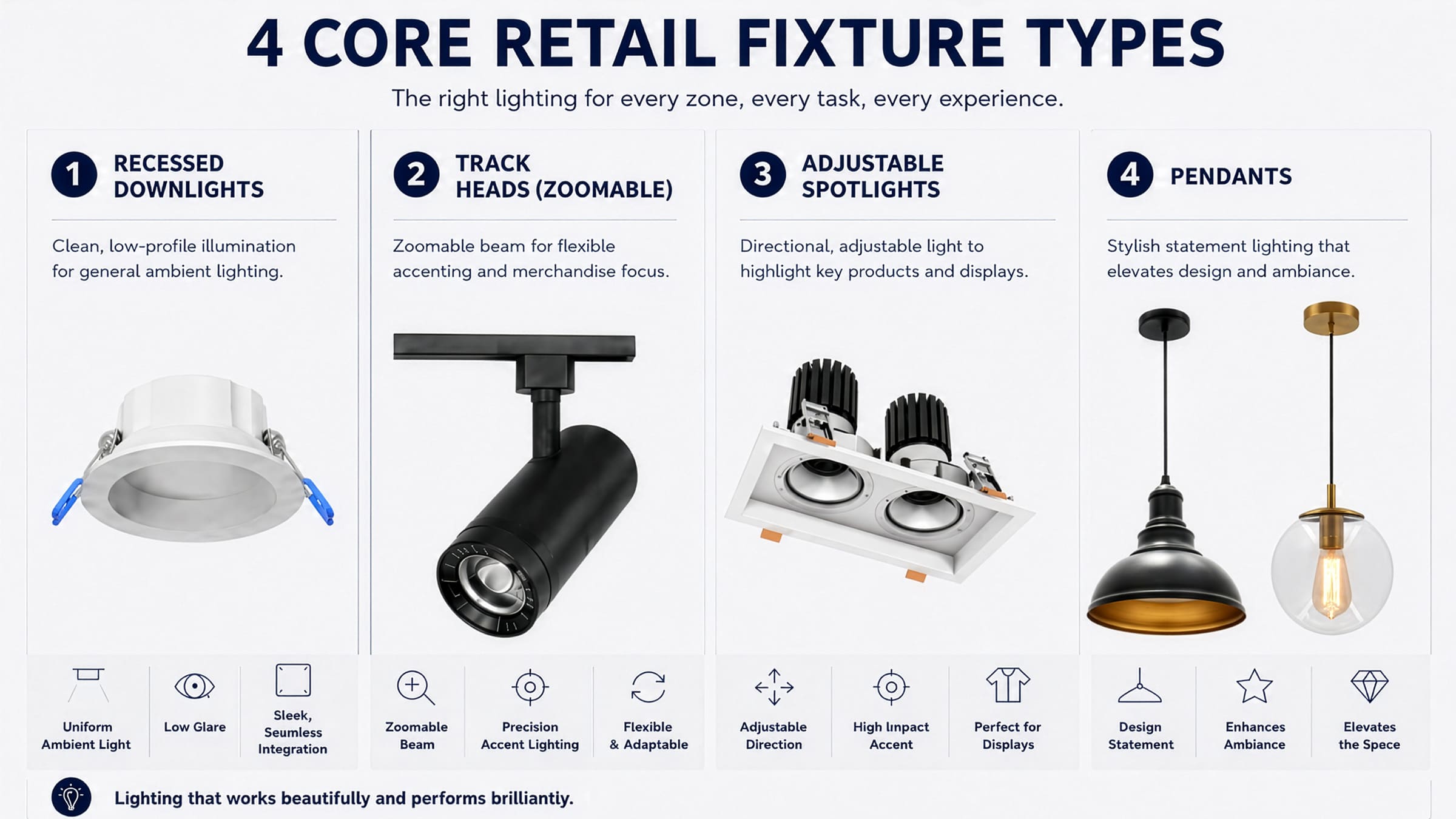
Retail lighting design typically relies on four primary fixture categories, each serving a distinct role within the layered lighting approach recommended by lighting professionals:
LED Recessed Downlights provide the foundational ambient layer. They sit flush with the ceiling for a clean, modern appearance and deliver uniform illumination across the sales floor.
Track Lighting offers flexibility and directional control. Fixtures can be repositioned along the track as merchandise displays change, making this a favorite for seasonal retail layouts.
Adjustable Spotlights serve as precision accent tools. They allow store designers to focus intense light on key products, mannequins, or featured displays.
Pendant Accent Lighting adds visual interest and architectural character to a space. Cylinder pendants and decorative suspensions work well over checkout counters, island displays, and boutique focal points.
The most effective retail lighting strategies use all four types together in a layered approach: ambient light for general visibility, accent light to highlight products, and decorative light to reinforce the store's brand identity.
Best Color Temperature for Retail Lighting
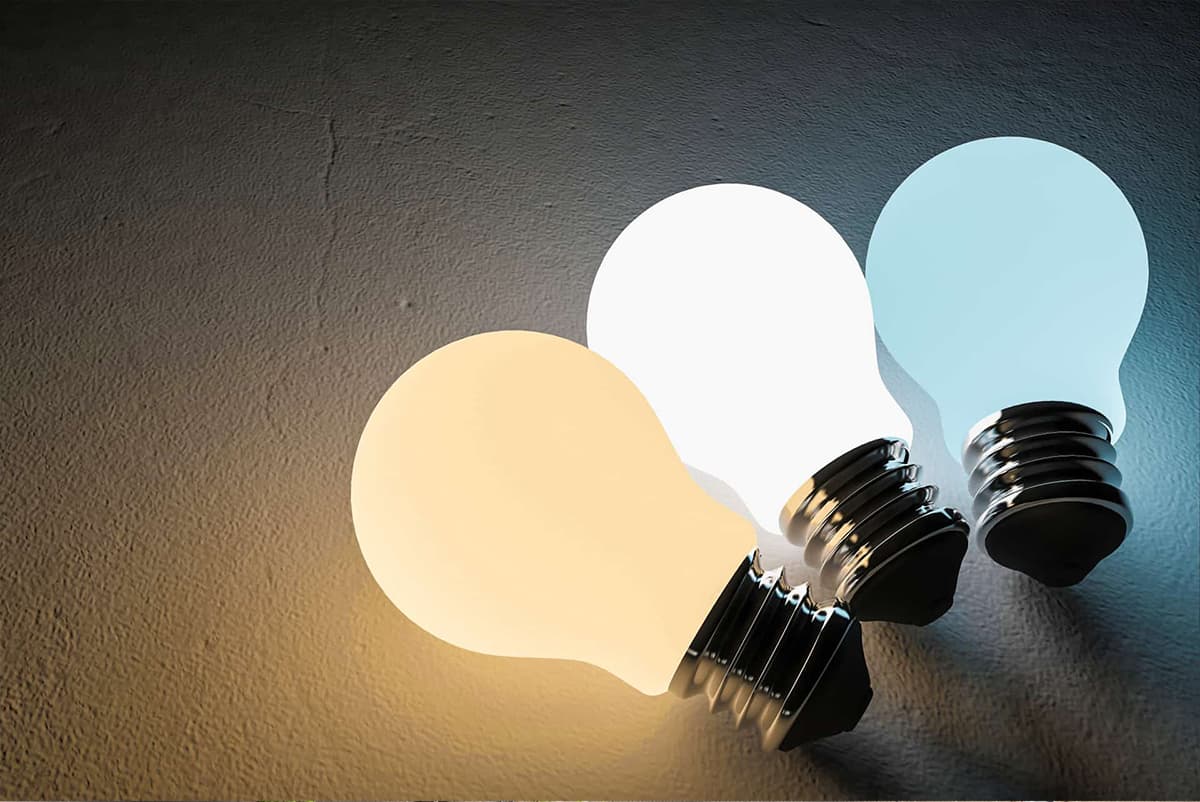
Color temperature, measured in Kelvin (K), defines the visual warmth or coolness of a light source. Choosing the right CCT for your retail space is essential because it sets the mood, supports your brand identity, and affects how customers see your products.
The IES Recommended Practice for Lighting Merchandising Areas (RP-2) states that the required CCT and color rendering quality will vary depending on the target market and the store concept. There is no single right answer, but the following guidelines are well supported by industry practice.
| Color Temperature | Best Used For | Mood / Effect |
|---|---|---|
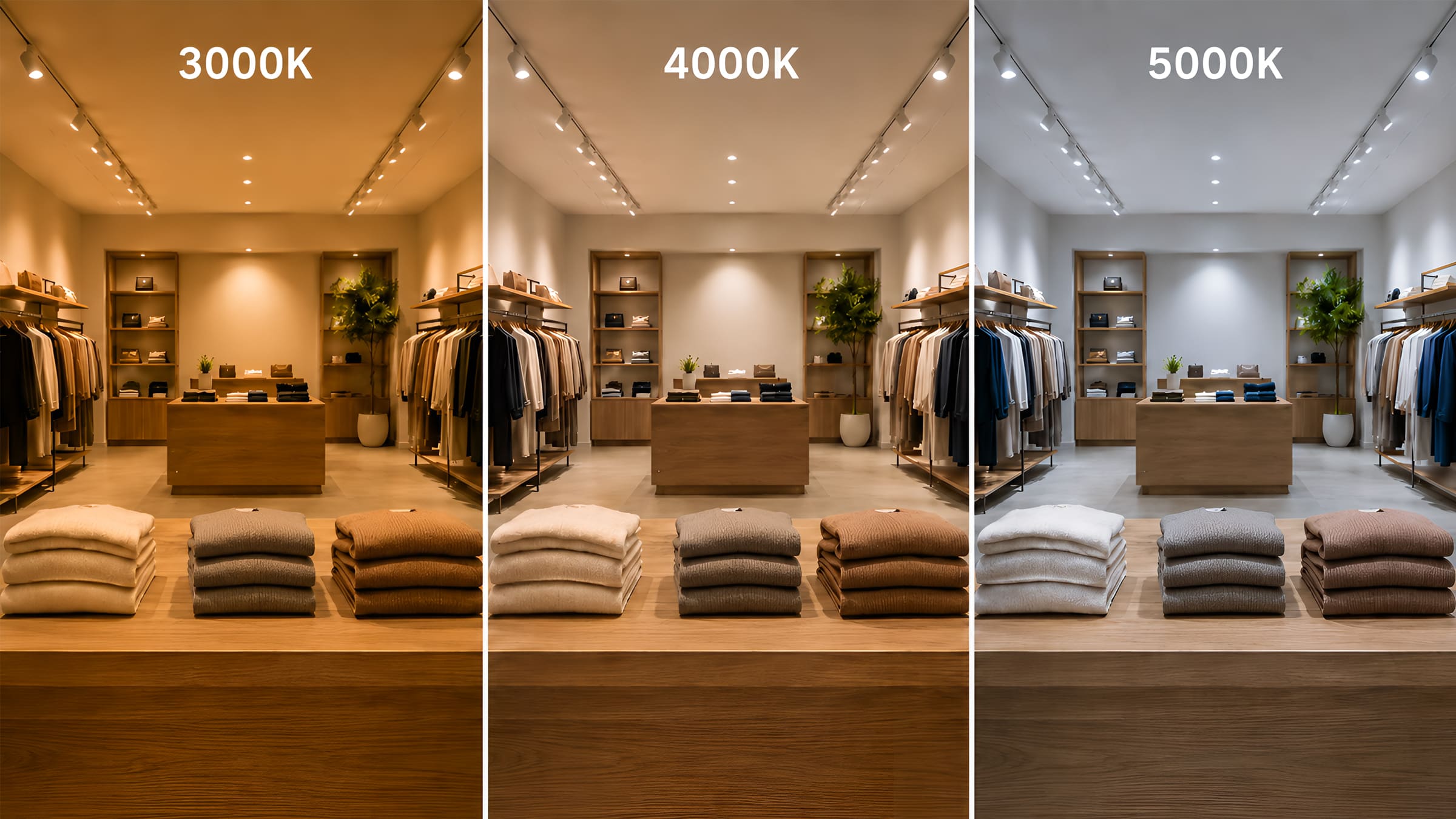
| 3000K (Warm White) | Boutiques, fashion stores, jewelry shops, high-end retail | Warm, inviting, intimate. Flatters skin tones and enhances rich fabrics. |
| 4000K (Neutral White) | General retail, electronics, home goods, department stores | Clean, balanced, professional. Most versatile for a wide range of merchandise. |
| 5000K (Daylight) | Warehouse-style retail, auto parts, big-box stores | Bright, energetic, high-visibility. Ideal for large open spaces. |
3000K: The Boutique Standard
Warm white lighting at 3000K creates a cozy, high-end feel that encourages browsing and lingering. It is the go-to choice for fashion boutiques, jewelry stores, and any retailer where ambiance and emotional connection matter. The warmth enhances skin tones in fitting rooms (especially when paired with a strong R9 red-rendering value) and makes warm-toned fabrics and wood displays look their best.
4000K: The Versatile Middle Ground
Neutral white at 4000K strikes the ideal balance between warmth and clarity. It is the most commonly recommended color temperature for general retail because it reproduces colors accurately without introducing a noticeable warm or cool bias. If you are outfitting a store that carries a mix of product categories, 4000K is usually the safest and most effective starting point.
5000K: The High-Energy Choice
Daylight-equivalent 5000K light is bright and energizing. It works well in warehouse-style or big-box retail environments where the priority is visibility and functionality over ambiance. Hardware stores, auto parts retailers, and large discount stores often benefit from this cooler temperature because it sharpens contrast and makes small details on packaging easier to read.
Recommended Retail Lighting Fixtures
Choosing the right fixtures is just as important as choosing the right color temperature and CRI. Below is a breakdown of the core fixture types used in retail, along with specific Westgate Lighting products suited for each application.
LED Recessed Downlights
Recessed downlights serve as the backbone of retail ambient lighting. They provide even, glare-controlled illumination across the entire sales floor without visual clutter on the ceiling. The ENERGY STAR program highlights recessed downlights as one of the most commonly installed commercial fixtures, with the DOE estimating over 600 million units in U.S. homes and businesses.
For retail applications, look for recessed fixtures with these characteristics: CRI of 90 or higher, selectable or fixed 4000K color temperature, dimmability for scene flexibility, and a beam angle wide enough for even floor coverage.
High CRI 90+ commercial recessed downlights with 5-CCT selectable technology (2700K/3000K/3500K/4000K/5000K) and adjustable power settings. Dual-dimming with 0-10V control. Designed for retail stores, hotels, offices, and premium commercial environments.
Compact mini linear LED fixture with 5 selectable color temperatures (2700K-5000K) for maximum project versatility. Great for general retail ambient lighting and architectural applications.
Minimalist 3" recessed downlight with a modern slot trim for a clean, linear architectural look. Ideal for upscale retail and boutique store ceilings where aesthetics matter.
LED Flat Panel Lights
For retail stores with drop-ceiling grid systems, flat panel LED lights offer a modern alternative to traditional fluorescent troffers. They deliver soft, uniform illumination with high efficiency.
125 lm/W efficiency with power and wattage selectable options. DLC Premium listed for utility rebate eligibility. Available in 2x2 and 2x4 formats.
High-efficiency panels rated at 110 lm/W with 50,000-hour life, 0-10V dimming, and no-flicker operation.
Glare Control in Retail Lighting
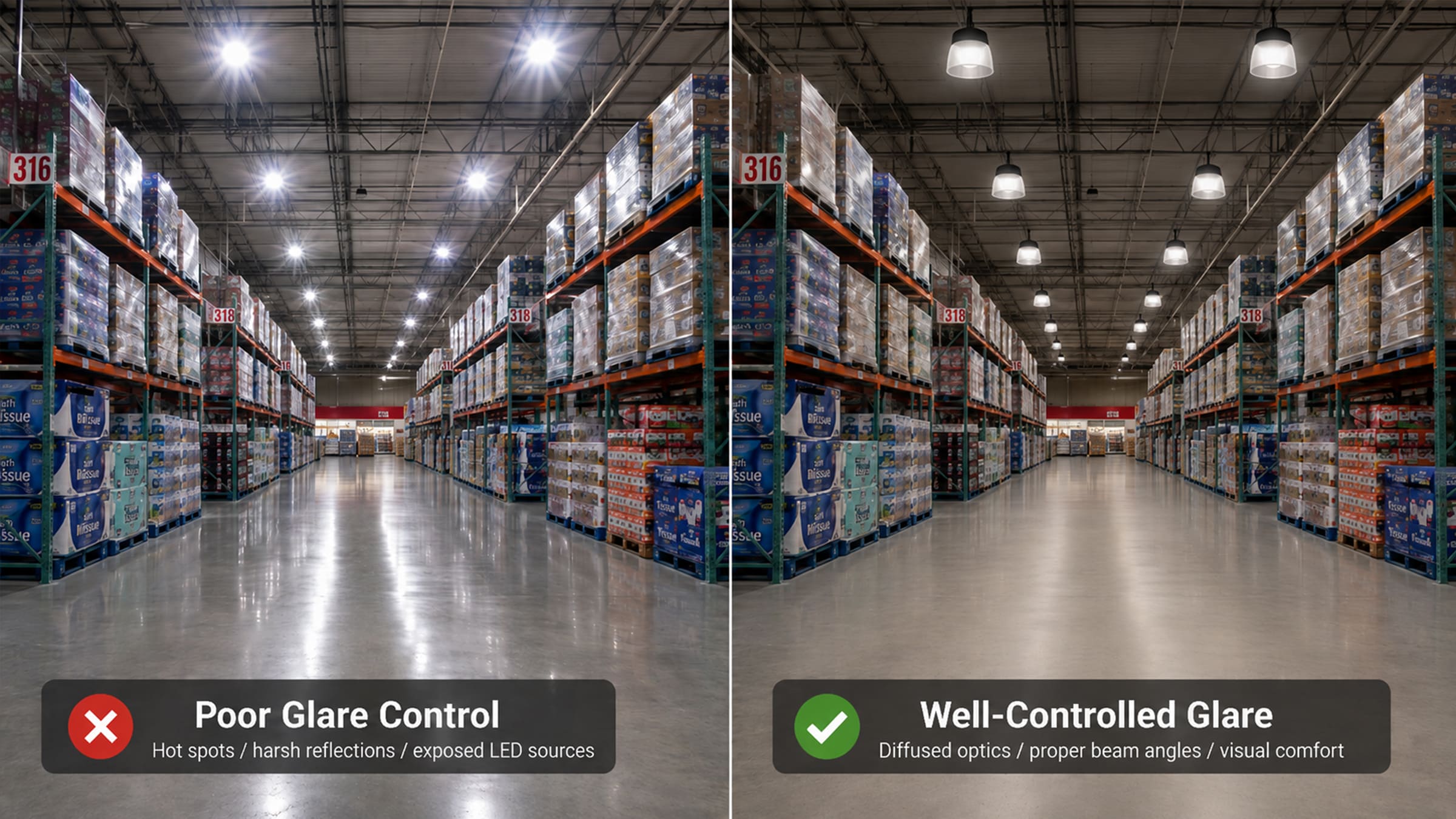
Brightness alone does not make a great retail environment; how that light is delivered matters just as much. Glare is one of the most common and costly mistakes in retail lighting design. When customers squint, shield their eyes, or feel visual discomfort, dwell time drops and the shopping experience suffers. Getting glare under control is as important as hitting the right fc target.
Understanding UGR: Unified Glare Rating
The Unified Glare Rating (UGR) is the international standard used to quantify discomfort glare from interior lighting. It runs on a scale where lower numbers mean less glare. For retail environments, the IES and European lighting standards generally recommend a UGR of 19 or below on the general sales floor, and 16 or below in areas where customers are stationary for longer periods, such as fitting rooms and checkout counters.
When specifying fixtures, always check the photometric data sheet for UGR values. Many Westgate commercial fixtures publish UGR ratings alongside their lumen output and beam angle data.
Beam Angle and Fixture Placement
Glare is heavily influenced by beam angle and mounting position. Narrow-beam fixtures (10–25°) aimed directly at merchandise are ideal for accent lighting, but the same fixture aimed toward an aisle or customer eye level becomes a glare source. As a rule of thumb, accent fixtures should be aimed at an angle no greater than 30° from vertical to keep the light source out of the customer's direct line of sight.
For ambient recessed downlights, wider beam angles (60–90°) spread light more evenly and reduce the luminance contrast between the fixture and the surrounding ceiling, a key driver of discomfort glare in retail environments.
Lens Diffusion and Shielding
Opal or frosted diffuser lenses spread light output across a wider surface area, dramatically lowering the perceived brightness of the fixture face without reducing the total lumens delivered to the floor. For pendant and cylinder fixtures, particularly those hung at eye level over checkout counters, a diffused lens is strongly recommended over a clear or open aperture design.
Deep-baffle recessed fixtures and fixtures with internal baffles or louvers provide mechanical shielding that prevents the LED source from being visible at wide viewing angles. This is particularly valuable in stores with high ceiling reflectance or polished floor finishes, where reflected glare can compound the problem.
Lighting Controls and Smart Dimming
Choosing dimmable fixtures is only half the equation. How you control those fixtures determines whether your store meets energy code requirements, responds intelligently to occupancy, and gives your staff the flexibility to create the right atmosphere at any time of day. ASHRAE 90.1, the primary energy standard for commercial buildings in the U.S., requires automatic lighting controls in virtually all retail spaces, making controls a compliance necessity, not just a convenience.
Well-implemented lighting controls can reduce a retail store's lighting energy consumption by 30 to 50 percent beyond what efficient fixtures alone deliver, through a combination of occupancy sensing, daylight harvesting, and scheduled scene changes.
Westgate Controls: Motion Sensors and Smart Dimming
Westgate's own control line covers the essentials for retail stores that need reliable, code-compliant automation without complex programming. The WEC Motion Sensor series provides hands-free automatic lighting that turns fixtures on when areas are occupied and off when they are not, a requirement under ASHRAE 90.1 for most commercial retail spaces. The Westgate Smart Dimming Control Modules and Smart Dimming Wall Switches work with compatible Westgate fixtures and the Westgate Smart App, allowing staff to adjust scene levels from a mobile device. This is a practical starting point for boutiques and smaller retail spaces that want app-based scene control without a dedicated networked system.
WEC Motion Sensors, Smart Dimming Control Modules, and Smart Dimming Wall Switches. Compatible with the Westgate Smart App for mobile scene control.
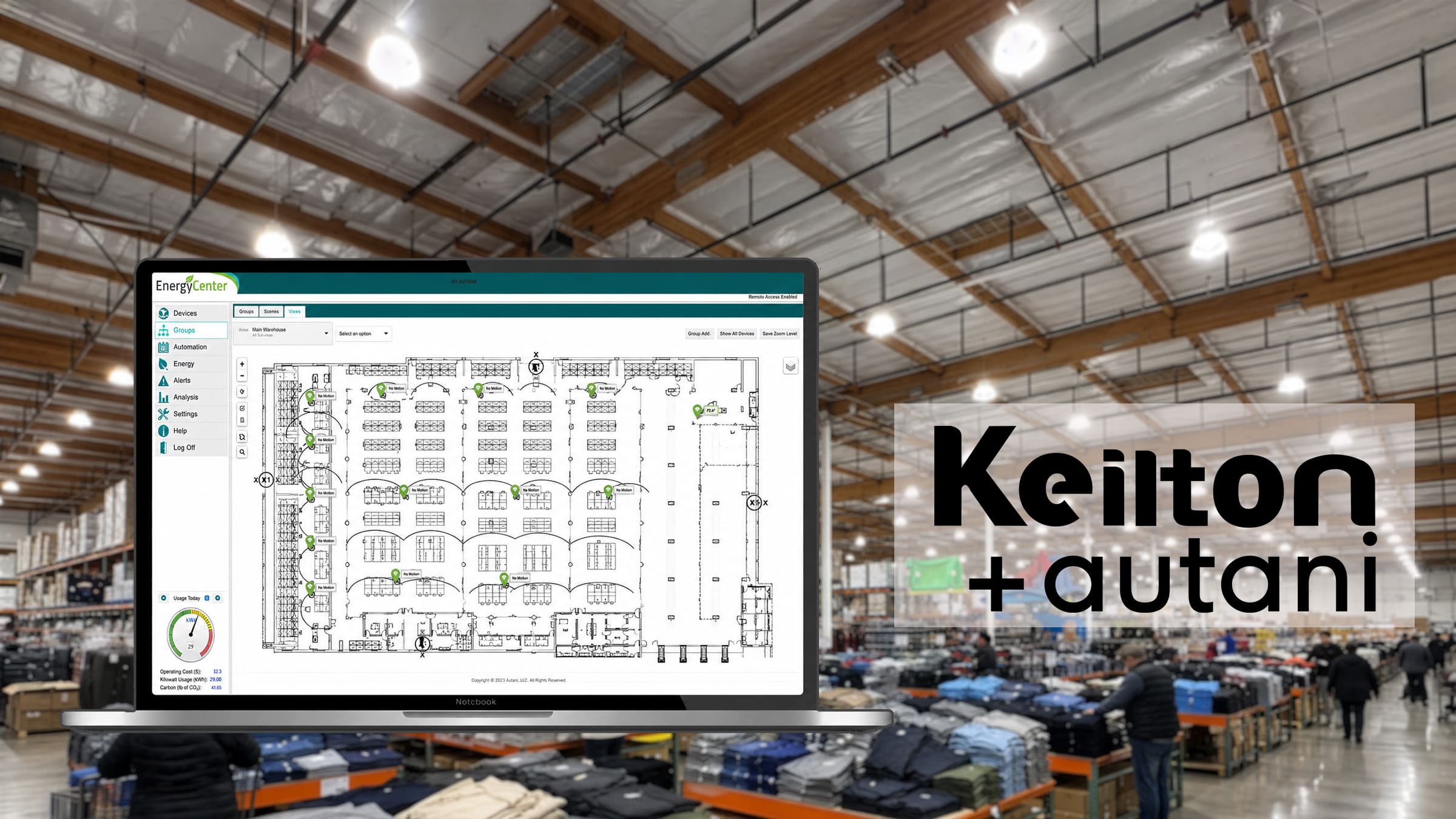
Keilton Autani: Networked Commercial Controls
For larger retail environments that require scalable, code-compliant occupancy sensing, daylight harvesting, and centralized scheduling, Westgate has partnered with Keilton Autani, a commercial-grade smart lighting control platform. The Keilton Autani lineup available through Westgate includes Bluetooth high bay and low bay motion sensors for open sales floors, ceiling occupancy sensors, microwave sensors for areas with slow-moving occupants such as stockrooms, line-voltage fixture controllers, integrated Bluetooth adapters, and smart wall switches that allow staff to adjust zones without a device. Keilton Autani systems support centralized control, scheduling, and energy management, making them well suited for larger floor plates where full automation and reporting are required.
Smart Bluetooth high bay and low bay sensors, ceiling occupancy sensors, microwave sensors, wall switches, line-voltage fixture controllers, and integrated Bluetooth adapters for networked commercial retail environments.
Homewell GEBC: Bluetooth Mesh Controls
For stores using a drop-ceiling grid system or requiring a wireless retrofit solution, the Homewell GEBC Bluetooth mesh series offers dimming and CCT control without a hub or gateway. The lineup includes wireless fixture controllers, Bluetooth dimmer wall switches, networked PIR and microwave occupancy sensors, a network microwave extender node for larger spaces, and an energy monitoring USB dongle for real-time consumption tracking. The GEBC series is designed for commercial and architectural environments and can be retrofitted into existing layouts with minimal disruption.
Bluetooth mesh dimming and CCT fixture controllers, wireless dimmer wall switches, PIR and microwave occupancy sensors, network extender nodes, and energy monitoring. No hub required.
Accent Lighting for Merchandise
Accent lighting is what separates a well-lit store from a truly compelling retail environment. While ambient lighting provides baseline visibility, accent lighting draws the customer's eye to featured products, seasonal displays, and high-margin items. The IES RP-2 Recommended Practice for Retail Lighting identifies accent lighting as a critical layer in effective merchandising.
A common rule of thumb among lighting designers is the 3:1 accent ratio: accent-lit merchandise should be roughly three times brighter than the surrounding ambient light. For hero products or window displays, ratios of 5:1 or higher are often used. See the recommended fc targets by zone for specific brightness benchmarks.
Track Lights
Track lighting is the most popular accent lighting solution in retail because of its inherent flexibility. Fixtures mount to an electrified track and can be repositioned, aimed, and swapped as displays change. For guidance on keeping accent fixtures from becoming glare sources, see the beam angle recommendations in the Glare Control section.
CRI 90+ with 20-50 degree adjustable beam. Multi-CCT (2700K-5000K), TRIAC/ELV dimming. 70,000 hours. Designed for retail, galleries, and museums.
CRI 93-95 with 10-60 degree zoomable beam. 7-year warranty, 70,000-hour life. Gallery-quality accent lighting for retail.
Power and CCT adjustable. Cost-effective entry point for retail track lighting projects.
Adjustable Spotlights
Adjustable spotlights and recessed gimbal fixtures offer focused accent lighting from fixed ceiling positions. These work well for permanent product displays, wall-wash applications, and feature walls.
3" adjustable eyeball LED downlight with 5-CCT selectable color temperatures for ultimate project flexibility. Combines the clean look of a recessed downlight with directional accent and task lighting capability.
Architectural winged recessed downlight featuring a sleek double-slot LED design with 45-degree adjustability all around. Combines the refined linear aesthetic of a fixed downlight with directional accent capability, making it ideal for upscale retail and modern commercial spec projects that demand both clean ceilings and precision aiming.
Pendant Accent Lighting
Cylinder and decorative pendant lights create visual anchors within the store layout. Hung over checkout counters, center island displays, or dining areas in mixed-use retail, they serve both a functional and aesthetic purpose.
Timeless frosted glass globe pendant with built-in Multi-CCT switch (5 selectable color temperatures). Available in Gold or Black architectural finish. Durable construction with efficient LED technology makes it a stylish, long-lasting choice for checkout counters, display tables, and boutique focal points.
Contemporary dome-shaped pendant with a clean architectural silhouette. Perfect for checkout counters, retail islands, and modern boutique interiors where a sleek, statement-making fixture is desired.
Decorative cone-shaped pendant with selectable CCT and power for maximum project flexibility. Includes a 4.5 ft. adjustable downrod, making it suited for boutique retail, cafes, and fashion stores with varied ceiling heights.
How Many Lumens Does Retail Lighting Need?
Getting the brightness right is critical. Too little light and your store feels dull and uninviting; too much and customers experience glare and discomfort. The Illuminating Engineering Society (IES) provides recommended illuminance levels for various retail areas, measured in lux (lumens per square meter) or footcandles (lumens per square foot).
| Retail Area | Target (fc) | Target (Lux) | Purpose |
|---|---|---|---|
| General sales floor | 50 - 100 | 500 - 1,000 | Comfortable ambient lighting for browsing |
| Merchandise displays | 100 - 200 | 1,000 - 2,000 | Draw attention and reveal product detail |
| Featured / accent displays | 200+ | 2,000+ | Maximum impact for hero products and windows |
| Fitting rooms | 20 - 50 | 200 - 500 | Flattering, diffused light for try-on experience |
| Checkout / POS | 50 - 75 | 500 - 750 | Task visibility without harsh glare |
| Storage / back-of-house | 20 - 30 | 200 - 300 | Functional visibility for stocking |
How to Calculate Total Lumens Needed
For example, a 2,000 sq ft retail sales floor targeting 50 footcandles of ambient light would require approximately 100,000 lumens of total output distributed across the ceiling. If you plan to use fixtures that deliver 3,000 lumens each, you would need roughly 33 to 34 fixtures. Actual fixture count will vary based on ceiling height, fixture beam angle, surface reflectance, and layout uniformity goals.
For a more precise calculation, professional lighting designers use photometric software and the IES zonal cavity method. You can also reference photometric data available on individual product pages at westgatemfg.com.
Retail Lighting Layout Example
A well-designed retail lighting layout uses layered lighting to guide customers through the space, highlight key merchandise, and create a comfortable atmosphere. The interactive layout below shows recommended zones, fc targets, and Westgate fixtures for each of the five major retail store types. Select a store type and tap any zone to view detailed lighting recommendations.
Frequently Asked Questions
What is the best lighting for clothing stores?
Clothing stores benefit most from 3000K to 3500K ambient lighting with accent lighting at CRI 90 or higher. The warm base creates an inviting atmosphere, while high-CRI accent lights on racks reveal true fabric colors. Fitting rooms should use diffused, warm lighting with a strong R9 value. The IES RP-2 practice guide emphasizes red-spectrum rendering for accurate warm tones in fabric-heavy retail.
Should retail lighting be warm or cool?
It depends on the store type. Warm (3000K) works best for boutiques and luxury retail. Cool (4000K-5000K) is better for warehouse-style stores and electronics. Most general retail falls in the 3500K-4000K range. The ENERGY STAR commercial lighting guide recommends matching lighting to both the application and desired customer experience.
Is 4000K good for retail lighting?
Yes. 4000K is the most widely recommended color temperature for general retail. It provides neutral, balanced white light that renders product colors accurately. It is bright enough to feel clean and professional while remaining comfortable for extended browsing.
How much does it cost to light a retail store with LEDs?
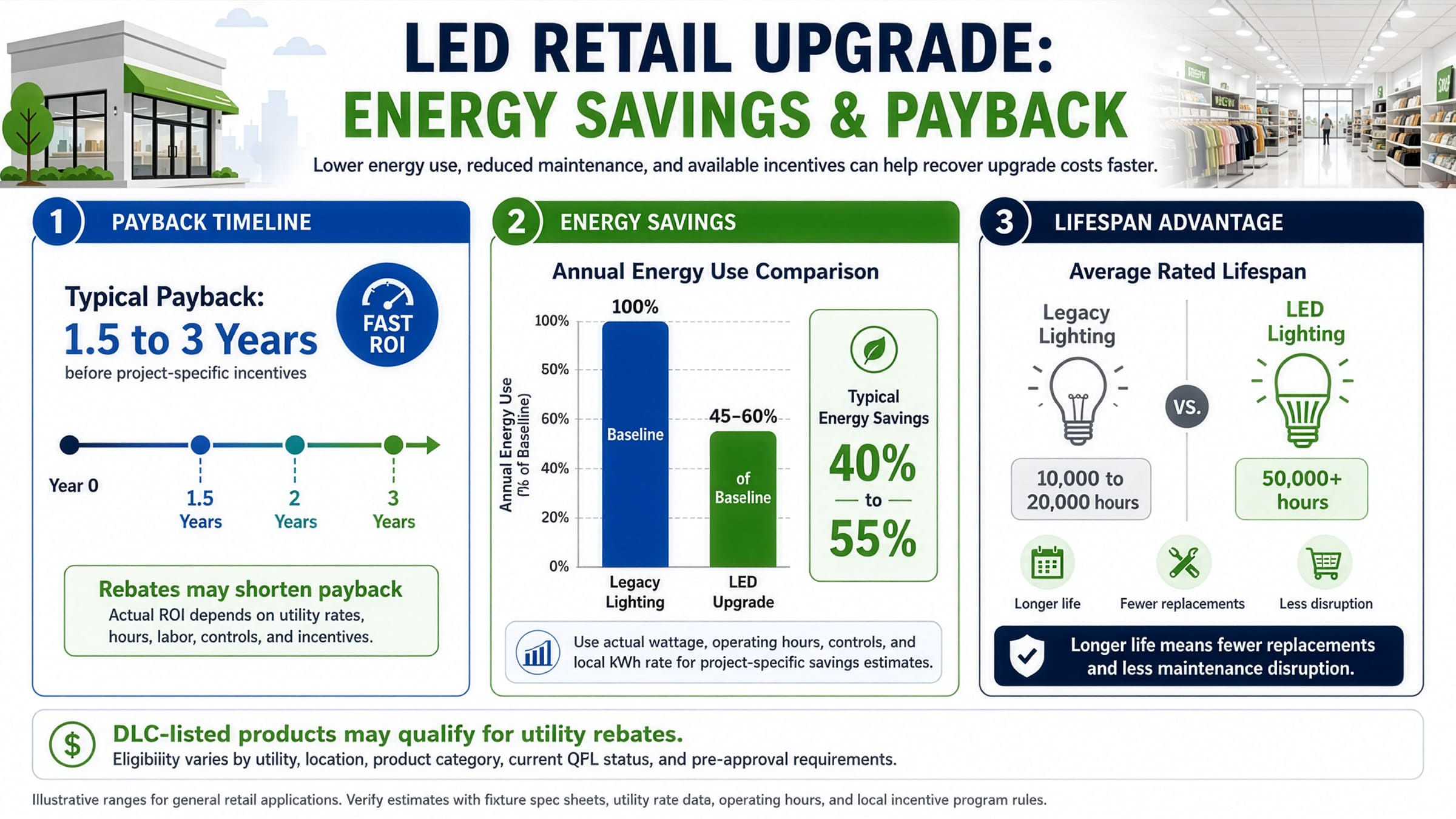
Costs vary based on store size, ceiling height, and design complexity. The U.S. Department of Energy reports that LED lighting uses at least 75% less energy than incandescent systems. Most retail LED upgrades pay for themselves within two to four years through reduced energy and maintenance costs. DLC-listed fixtures can qualify for utility rebates that further reduce upfront costs.
What is the difference between ambient, accent, and task lighting?
Ambient lighting is the general illumination that allows customers to move through the store comfortably. Accent lighting is focused light aimed at specific products to create visual contrast. Task lighting provides concentrated light for functional activities like checkout. Effective retail design layers all three types together.
Do I need dimmable LED fixtures in a retail store?
Dimming is highly recommended. It lets you adjust light levels throughout the day, create mood variations for events, and fine-tune the ambient-to-accent balance. Most Westgate commercial fixtures, including the TRS and TRD track heads, support TRIAC or 0-10V dimming. For a full overview of control options from simple wall switches to networked occupancy systems, see the Lighting Controls and Smart Dimming section.
Retail Lighting Checklist (Summary)
Color and Quality
Brightness and Distribution
Fixture Selection
Design and Control
Efficiency and Compliance
Additional Resources
- Illuminating Engineering Society (IES) - Industry standards and the IES Lighting Handbook
- U.S. Department of Energy - LED Lighting - Energy savings data and LED technology overview
- ENERGY STAR Commercial Lighting - Certified product guidance and upgrade recommendations
- DesignLights Consortium (DLC) - Qualified product lists for utility rebate eligibility
- Westgate Lighting Full Catalog - Browse the complete product lineup
- Westgate Commercial Indoor Lighting - All commercial interior fixtures
- Westgate Architectural Indoor Lighting - Architectural and decorative options