
Updated: July 1, 2026
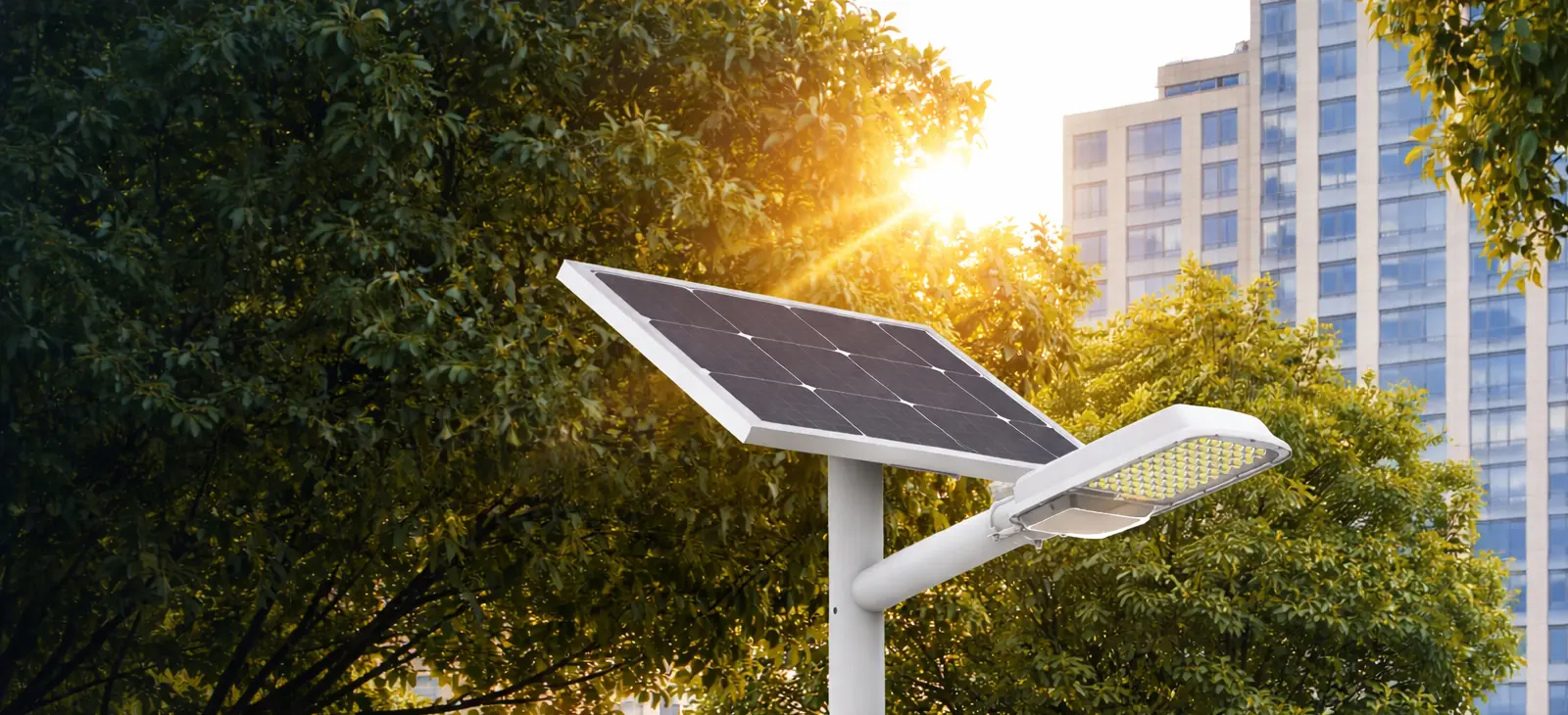
Commercial solar lighting has crossed the line from niche to mainstream. Today's fixtures pair high-efficiency LED engines with monocrystalline panels and lithium batteries that store enough energy to run dusk-to-dawn, even through cloudy stretches. For property managers, contractors, and specifiers, that means dependable outdoor light in places where running power is slow, disruptive, or simply not worth the cost.
Westgate Manufacturing builds a full lineup of commercial solar outdoor lighting, from high-lumen LED solar lights for roadways and parking lots down to low-level solar bollards for walkways and plazas. This guide walks through where solar makes sense, how a modern system actually works, which fixture fits which job, and what a finished installation looks like, using a recent project by one of our distributor at Oceana Coffee in Florida as a real-world example.
Table of Contents
The case for going off-grid
01Why commercial solar lighting makes sense now
Two trends meet in a solar fixture. First, LEDs have made outdoor lighting dramatically more efficient: the U.S. Department of Energy reports that LED lighting uses at least 75% less energy and lasts up to 25 times longer than incandescent sources.1 Second, outdoor lighting is a meaningful slice of commercial energy use, and the outdoor sector has adopted LEDs faster than indoor, accounting for roughly 40% of all LED lighting energy savings in a recent DOE assessment.2 Solar takes the next step: it powers those efficient LEDs with energy the panel collects on-site, so the fixture draws nothing from the grid.
The operational case is just as strong. A conventional pole light needs trenching, conduit, wire, and an electrical tie-in, work that drives up labor, permitting, and site-disruption costs before the first photon is produced. A self-contained solar fixture skips all of it. That is why solar is often the practical choice for parking lots far from a panel, perimeter and security zones, remote pathways, signage, and additions to sites where the existing service is already maxed out.
Solar's biggest savings often aren't on the energy bill, they're in the install. No trench, no conduit, no electrician tie-in means lower labor, simpler permitting, and far less disruption to a working site.
Anatomy of a fixture
02How a modern solar light actually works
A commercial-grade solar fixture is a small, self-managing power system. Four parts do the work, and the quality of each is what separates a dependable luminaire from a disposable one.
Monocrystalline solar panel
The panel converts daylight into electricity. Westgate uses high-efficiency monocrystalline panels, which deliver more output per square inch than older polycrystalline cells, important when panel area is limited. On split-panel models the panel mounts separately from the light head, so it can be aimed at the sun while the fixture lights the target area.
LiFePO4 battery with smart management
Energy collected during the day is stored in a lithium iron phosphate (LiFePO4) battery. This chemistry is prized for thermal stability and long service life: Westgate's batteries are rated for more than 2,000 charge cycles, roughly five-plus years of nightly operation, with built-in overcharge and over-discharge protection.
Smart lighting controller
An onboard controller decides how the stored energy is spent. Dusk-to-dawn photocell activation turns the light on automatically at night, and depending on the model you can layer in motion-activated dimming, programmable timers, and remote-set output, so the fixture stretches its charge across longer winter nights.3
LED engine and optics
Finally, an efficient LED array paired with a purpose-built optic puts the light where it's needed. Type III optics, for example, throw a wide, forward distribution suited to roadways, parking aisles, and area lighting.
Real specs: SOLA-SPLT Roadway & Area Solar Split Light
Representative model- Solar panel
- 17W monocrystalline
- LED wattage
- 15W / 30W
- Light output
- 2,250 / 4,500 lm
- Efficacy
- 150 lm/W (Lumileds)
- Color temperature
- 5000K · CRI >80
- Battery
- LiFePO4 · >2,000 cycles
- Charge time
- 6–12 hrs
- Runtime, full charge
- ~10 hrs
- Optics
- Type III, anti-UV PC lens
- Ingress / location
- IP65, wet location
- Operating temp
- -4°F to 104°F
- LED lifespan
- 70,000 hrs
Specs shown for the SOLA-SPLT Series; runtime and charge time vary with available sunlight. Each fixture page includes a built-in solar calculator that estimates performance for a specific address.
Match the fixture to the job
03The Westgate commercial solar lighting lineup
Westgate's solar collection spans the full range of outdoor needs, from high-output area and street lighting to architectural bollards, sign lights, and wall-mounted luminaires. Every product is engineered for autonomous, grid-free operation with no trenching and no conduit. Here's how the families map to applications.
Solar area, street & flood lights
The workhorses. The SOLN and SOLF series deliver high-lumen solar area lights for large spaces, available from roughly 10W to 70W with output reaching up to 14,000 lumens, enough to handle parking lots, roadways, perimeters, and campus walkways with the performance of a wired fixture. The split-panel SOLA family separates panel from head for tricky sun angles.
GPX adjustable solar area / flood
When aiming flexibility matters, the GPX-SOLAR adjustable solar area and flood light offers single-arm, pole/wall, and slip-fitter mounting with multi-CCT selectability, so one fixture covers area lighting, façade wash, and signage accents. The same solar engine also powers Westgate's modular solar bollards.
Solar bollard lights
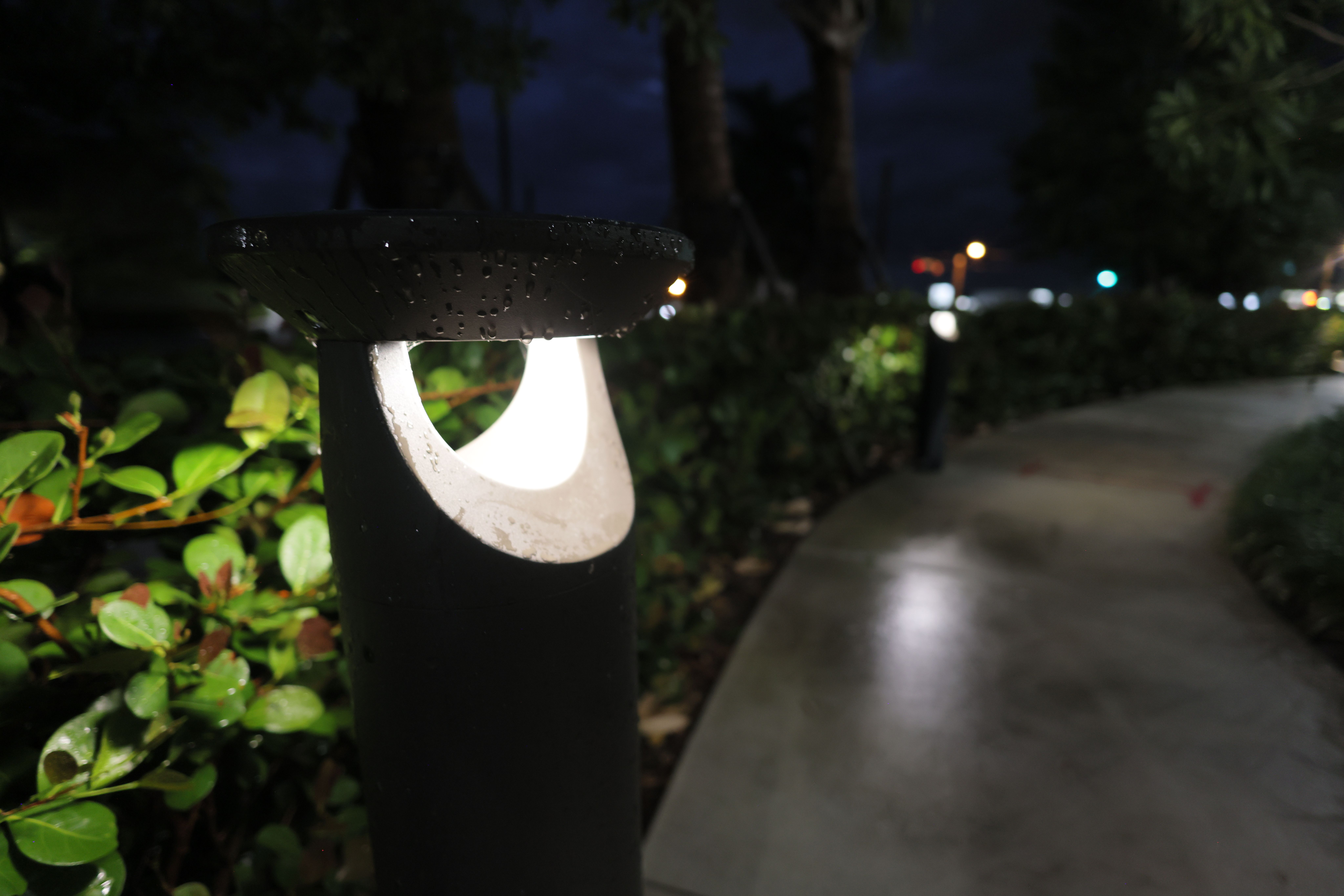
For pathways, plazas, entrances, and landscape zones, the BOL-G4 and BOL-G5 modular solar bollard systems provide clean, low-profile illumination at a human scale. Grid-free, offered in bronze or black with selectable color temperatures, a solar bollard light adds wayfinding and safety without the cost of trenched low-voltage runs.
Solar sign & billboard lights
Keep monument signs, billboards, and wayfinding lit after dark without running power to the sign. The SOLS-PRO series adds universal mounting and remote control; the SOLS series covers sign and billboard duty in compact 1-, 2-, and 4-foot formats.
Solar wall luminaires
The SOLW family, EdgeRay, WallRay, and LedgeRay, brings solar power to wall-mounted outdoor lighting for building exteriors, entries, and security applications where a clean, integrated look matters as much as coverage.
DAB-SOL designer area lights
For settings that call for a more traditional look, the DAB-SOL Designer Area Bell Light pairs bell-shaped fixtures with a solar engine and pole-top adapters for 3-, 4-, or 5-inch poles, in single or double-arm configurations up to 50W with multi-CCT selectability.
Latest project · Florida
Case study: the Oceana Coffee solar lighting upgrade
Oceana Coffee, an award-winning specialty roaster in Florida, needed dependable exterior lighting for one of it's cafe in Lake Park site, without tearing up a working property to run power.
The challenge
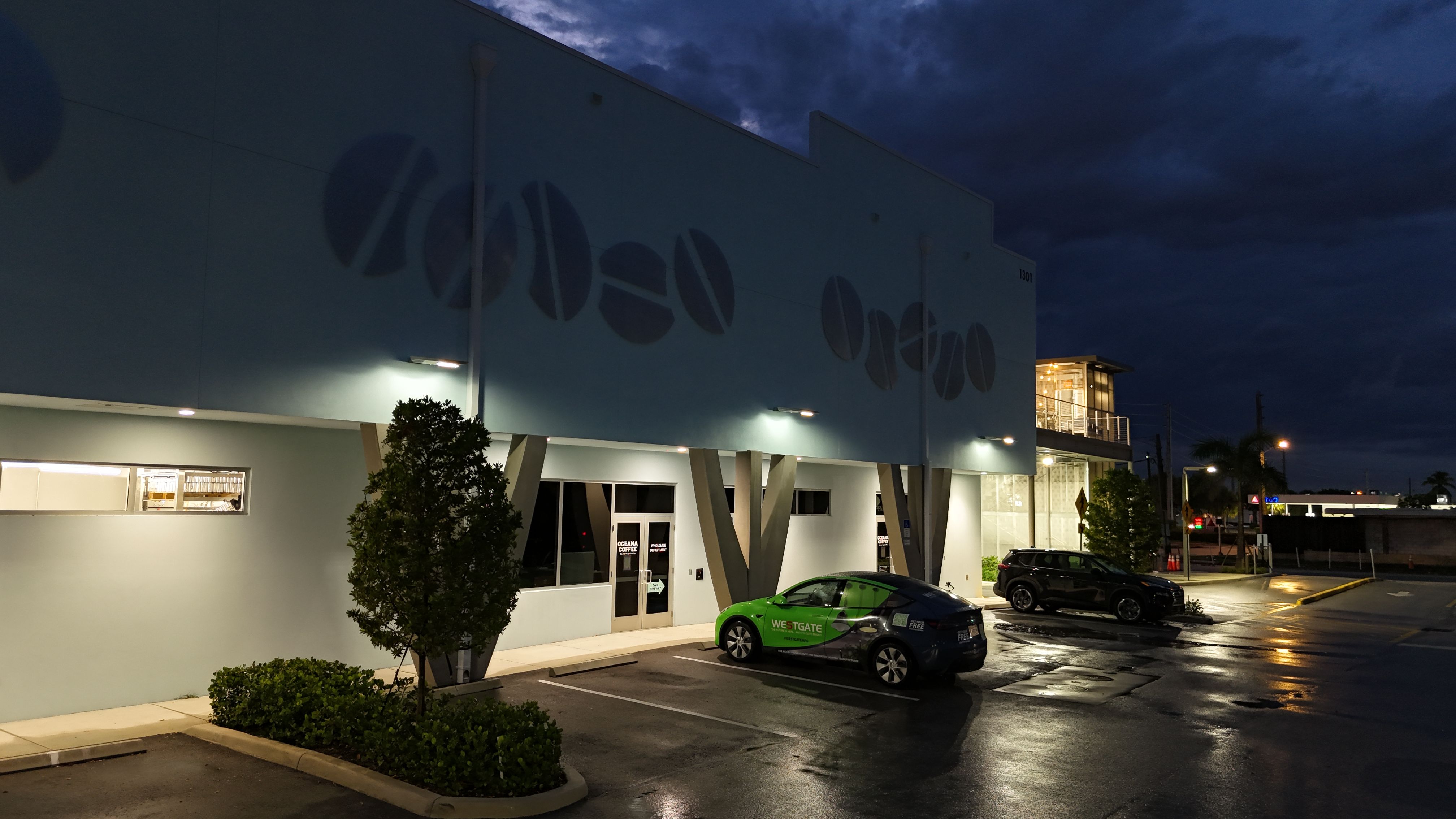
Oceana Coffee wanted to improve visibility, safety, and the overall exterior experience for customers, employees, and visitors. The property needed light across walkways, parking areas, building perimeter spaces, and outdoor customer-access zones.
A traditional wired installation would have meant trenching, conduit, and added electrical work, more complexity and more disruption to a business that's open daily.
The solution
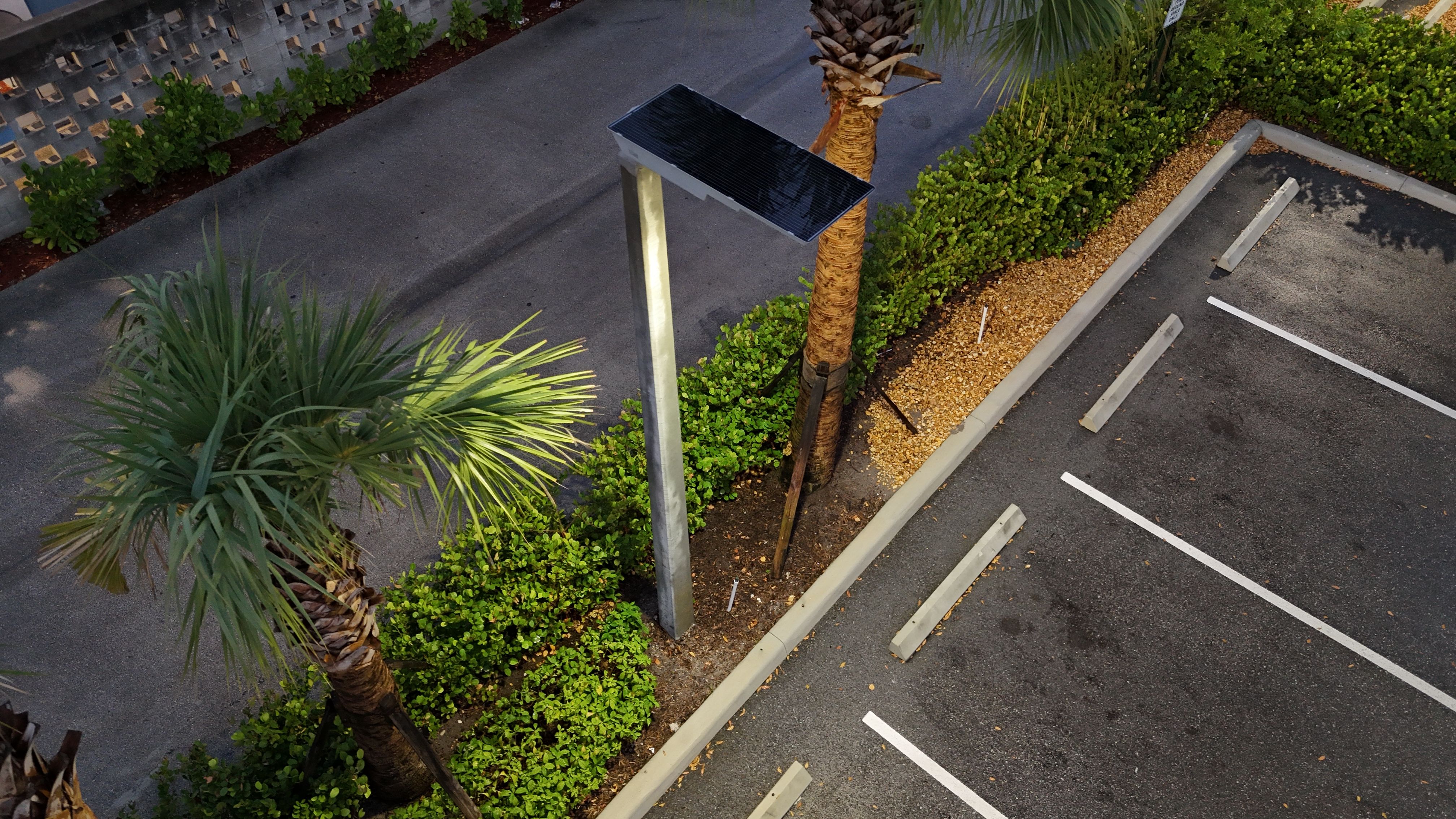
Westgate supplied a complete solar package: SOLN, SOLA, and SOLF solar area lights for the larger open spaces, plus BOL-G5 solar bollards for pathway and pedestrian lighting. The area lights used flexible pole-mount and wall-mount options; the bollards added clean, low-level light along walkways, entrances, and landscape areas.
Results & benefits
- Improved visibility across outdoor areas, walkways, and parking zones
- Solar-powered throughout, with no trenching or wiring required
- Flexible pole-mount and wall-mount installation options
- Clean, modern exterior lighting for customer-facing spaces
- Enhanced safety and comfort for customers, employees, and visitors
- Energy-efficient, off-grid operation powered entirely by the sun
- Layered illumination, area lights and bollards working together
See the installation in action.
Watch the project video →Specify with confidence
04Specifying responsible, code-ready solar lighting
Grid-free doesn't mean spec-free. The same standards that govern any commercial outdoor luminaire apply, and a few solar-specific details deserve attention on the takeoff.
- Wet-location, IP-rated housings. Commercial solar fixtures should carry wet-location ratings and IP65-rated enclosures so they hold up in real weather.
- Photometric documentation. Westgate publishes IES files, spec sheets, and installation manuals for every solar SKU, so the design can be modeled to IES standards from takeoff through commissioning. (IES LM-79 and LM-80 are the test methods behind LED photometric and lumen-maintenance data.)3
- Controls strategy. The DOE notes that networked and adaptive controls let exterior lighting respond to conditions and real-time activity for additional savings, exactly what dusk-to-dawn plus motion dimming delivers on a solar fixture.3
- Wind load (EPA). Pole-mounted panels add surface area; check the fixture's EPA rating against the pole and local wind requirements.
Light responsibly: the dark-sky principles
For sites near residential areas, coastlines, or sensitive habitat, responsible outdoor lighting also protects the night environment. DarkSky International's Five Principles for Responsible Outdoor Lighting are a useful checklist when specifying any exterior fixture, solar included.4
- 1Useful
Every light should have a clear purpose. If a fixture isn't needed, leave it out.
- 2Targeted
Direct light only where it's needed, using shielding and full-cutoff optics so it points down, not into the sky or onto neighbors.
- 3Low level
Use no more brightness than the task requires, accounting for reflective surfaces.
- 4Controlled
Use timers and motion sensors so light is on when useful, dimmed when possible, and off when not, a natural fit for solar's smart controllers.
- 5Warm color
Limit short-wavelength blue light; warmer color temperatures (around 3000K or lower) are preferred where appropriate. Westgate's multi-CCT solar models let you select a warmer output for dark-sky-sensitive sites.
Solar lighting and LEED certification
For projects pursuing green-building certification, outdoor lighting lands directly on the scorecard. LEED, the U.S. Green Building Council's certification program, is now in its fifth version, LEED v5, released in April 2025, with v4 and v4.1 still open for registration through mid-2027, so teams are working in both today.5 Under Sustainable Sites, LEED awards a Light Pollution Reduction credit (SSc6 in v5) for limiting uplight, glare, and light trespass.6
Compliance is documented with either the backlight-uplight-glare (BUG) rating method from IES TM-15-11 or a lumen-calculation method, both of which draw on each luminaire's published IES files and spec sheets. It's a single point, but it can be the one that lifts a project from Silver to Gold.6 Solar fits the brief on every count: downward Type III optics keep uplight low, dusk-to-dawn plus motion controls satisfy the control-strategy requirement, and Westgate publishes IES files for every solar SKU, exactly the data the BUG method needs. The panel's on-site renewable generation and zero grid draw also speak to the energy and decarbonization goals LEED v5 emphasizes. Confirm current credit requirements against your project's LEED version with a credentialed reviewer.
The numbers
05Cost, maintenance & long-term ROI
Solar fixtures often carry a higher unit price than a comparable wired luminaire, but the comparison that matters is total installed cost over the life of the system, and that's where solar tends to win.
On the install side, eliminating trenching, conduit, wiring, and the electrical tie-in can offset much or all of the fixture premium, while shortening the schedule and reducing site disruption. On the operating side, the fixture draws nothing from the grid, so there's no metered energy cost and no demand it adds to an already-loaded service. Maintenance is light too: LiFePO4 batteries rated beyond 2,000 cycles run for years before replacement, and LED engines are rated to 70,000 hours.
Many commercial solar lighting projects may also qualify for utility rebates or energy incentives. Programs change frequently and vary by location, so confirm current eligibility with your utility and a qualified tax professional, and check Westgate's rebate resources when you scope a project. (This is general information, not tax or financial advice.)
Rule of thumb: the further a fixture sits from existing power, the more strongly the math favors solar, because the cost you avoid in trenching and conduit grows with every foot of run.
Common questions
Frequently asked questions
Do commercial solar lights need any wiring or trenching?
No. Each fixture is a self-contained system, the solar panel, LiFePO4 battery, controller, and LED are integrated, so there's no trenching, conduit, or electrical tie-in. That's where solar saves the most on installation. Fixtures mount to standard poles or walls; on split-panel models the panel mounts separately and connects with a short lead. See the fixture lineup for mounting options.
How long do solar lights stay on at night?
It depends on battery capacity and how much sun the panel collected that day. A representative model like the SOLA-SPLT runs about 10 hours on a full charge, and dusk-to-dawn control keeps it on through the night. Motion-activated dimming and programmable output stretch runtime further across long winter nights.
Do solar lights work on cloudy days or in winter?
Yes. The LiFePO4 battery stores enough energy to carry the fixture through cloudy stretches, and the smart controller rations power so the light lasts until morning. Charge time runs roughly 6 to 12 hours of daylight depending on conditions, so panels should be sited for good sun exposure, split-panel models let you aim the panel independently of the light head. Each product page includes a solar calculator that estimates performance for a specific address.
How bright are solar area lights, and are they bright enough for a parking lot?
Yes. High-output solar area lights like the SOLN and SOLF series run from roughly 10W to 70W with output reaching up to about 14,000 lumens, enough to light parking lots, roadways, and perimeters with performance comparable to wired fixtures. The right wattage depends on mounting height and the area covered, send us your site and we'll design a layout to IES levels at no cost.
What is a solar bollard light, and where is it used?
A solar bollard light is a short, ground-level fixture, usually two to four feet tall, that lights walkways, plazas, entrances, and landscape areas at a pedestrian scale. Westgate's BOL-G5 modular solar bollards are grid-free and offered in bronze or black with selectable color temperatures, so they add wayfinding and safety without trenching low-voltage runs.
What kind of battery do solar lights use, and how long does it last?
Westgate uses lithium iron phosphate (LiFePO4) batteries, valued for thermal stability and long service life. They're rated for more than 2,000 charge cycles, roughly five-plus years of nightly operation, with built-in overcharge and over-discharge protection, and they can be replaced at end of life while the fixture stays in service.
Are commercial solar lights waterproof and weatherproof?
They're built for the outdoors: housings carry wet-location ratings and IP65 ingress protection, with die-cast aluminum bodies and UV-resistant lenses, and a representative operating range of about -4°F to 104°F. Because pole-mounted panels add surface area, check the fixture's EPA rating against the pole and local wind requirements, more on that in specifying solar lighting.
How much do commercial solar lights cost, and are they worth it?
A solar fixture often costs more per unit than a comparable wired one, but the comparison that matters is total installed cost. Eliminating trenching, conduit, and the electrical tie-in can offset much of that premium, and the fixture then draws nothing from the grid, with LED engines rated to 70,000 hours and batteries lasting years. The U.S. Department of Energy notes LED lighting uses at least 75% less energy than incandescent sources,1 and many projects also qualify for utility rebates. (General information, not financial advice, confirm current programs with your utility and a tax professional.) See cost & ROI for the full picture.
Can solar lighting help earn LEED certification?
It can contribute. Outdoor lighting factors into LEED's Light Pollution Reduction credit, and fixtures with downward optics, low uplight, dusk-to-dawn plus motion controls, and published IES files give the design team what they need to document it. On-site solar generation and zero grid draw also support the energy and decarbonization goals LEED v5 emphasizes, see specifying responsible, code-ready solar lighting.
Ready to specify solar for your next project?
Browse the full range of commercial LED solar lights, or send us your site photos, plans, or dimensions and we'll design a code-compliant solar layout tailored to your space, at no cost.
Sources & further reading
- U.S. Department of Energy, Office of Energy Saver, "LED Lighting." energy.gov/energysaver/led-lighting
- U.S. Department of Energy, "LED Adoption Report" (energy savings by sector). energy.gov/cmei/ssl/led-adoption-report
- U.S. Department of Energy, Federal Energy Management Program, "Purchasing Energy-Efficient Exterior Lighting" (controls, light-pollution reduction, IES LM-79 / LM-80). energy.gov/femp/purchasing-energy-efficient-exterior-lighting
- DarkSky International & IES, "Five Principles for Responsible Outdoor Lighting." darksky.org/resources/guides-and-how-tos/lighting-principles
- U.S. Green Building Council, "LEED v5" (current rating system; LEED v4 / v4.1 registration extended through June 30, 2027). usgbc.org/leed/v5
- U.S. Green Building Council, LEED Light Pollution Reduction credit (uplight, glare, and light trespass; BUG ratings per IES TM-15-11). USGBC Light Pollution Reduction credit guide
- Westgate Manufacturing, "Oceana Coffee Solar Lighting Upgrade" case study. westgatemfg.com/case-study